THE SHORT ANSWER
Full free lift (FFL) means the forks can rise to a useful height — typically 1.5 m or more — before the mast itself starts extending. Inside a shipping container with a 2.28 m ceiling, a non-FFL forklift can only lift a few centimetres before the mast hits the roof; an FFL machine can lift and stack pallets two-high without the mast moving.
The 2.28-metre problem
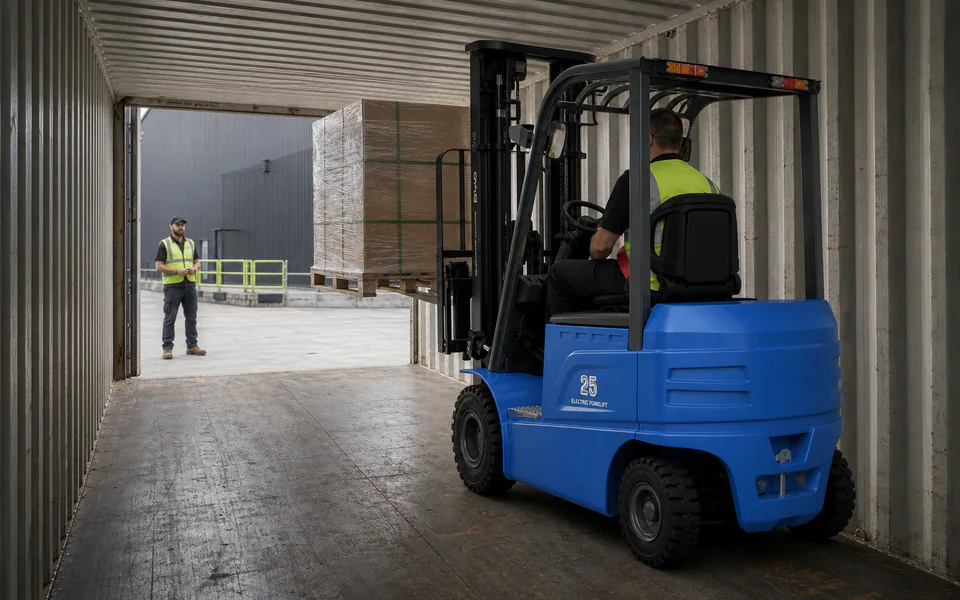
A standard shipping container’s internal height is about 2.28 m (2.69 m for high-cube). A typical triplex mast lowered sits around 2.0–2.2 m — it fits through the door. The trap is what happens next: on a mast with limited free lift, raising the forks even slightly raises the inner mast channels too. Inside a container, that means the mast hits the roof almost immediately, and your “2.5 tonne forklift” can’t lift a pallet high enough to stack it.
What free lift actually is
- Free lift (h2) is how far the forks rise before the mast sections start extending upward.
- A standard triplex mast might have only 130–195 mm of free lift — fine in open warehouses, useless in a container.
- A full free lift (FFL) triplex uses a centre-mounted free-lift cylinder so the carriage travels most of the lowered mast height — typically 1.4–1.7 m of lift with zero mast growth.
Two numbers decide container capability: mast lowered height (fits through the door?) and free lift (how high can you lift inside?). Everything else is marketing.
Which of our machines have it
| Model | Mast | Free lift | Container work |
|---|---|---|---|
| BYD EL20-Pro | 4.8 m triplex FFL | full free lift | ✓ designed for it |
| BYD EL25-Pro | 4.8 m triplex FFL | full free lift | ✓ designed for it |
| EP EFX5-251 | 4.5 m triplex | ~1,135–1,450 mm (3-free type) | partial — confirm door height |
| EP EFX5-351 | 4.5 m triplex | ~1,065–1,470 mm (3-free type) | partial — confirm door height |
| EP EFL181 | 4.8 m triplex | ~1,122–1,656 mm (3-free type) | light loads only |
The BYD machines are the clean answer for weekly container destuffing: FFL by design, plus 100A fast charging to absorb the stop-start duty. The EP 3-stage free masts have meaningful free lift — for occasional container entry they can work, but we check your exact door heights and load weights before saying yes.
Beyond containers: where FFL pays off
- Low doorways and mezzanine undersides — lift under a 2.4 m opening without mast strike
- Double-stacking in low-roof sheds — older Melbourne factories with 3–4 m eaves
- Racking first beams — placing pallets at 1.5 m without the mast rising into sprinkler zones
The capacity caveat
FFL masts carry their free-lift cylinder in the operator’s sightline and add weight to the carriage — and any mast’s capacity falls as lift height rises. A hang-on side shift stacks another deduction on top. None of this is a reason to avoid FFL; it’s the reason to check the load chart for the exact mast and attachment combination against your heaviest pallet. That check is standard in our fit assessment.
Mast figures from manufacturer brochures (EP V2311/V2503, BYD EL20/25-PRO datasheet), reviewed August 2026. Delivered machine load charts govern.