Food & Beverage · Melbourne
Forklift Hire for Food & Beverage
Food environments have the strictest air, the earliest starts and the least patience for downtime. Lithium electric removed every reason this industry ever had to tolerate LPG fumes near product.
Why food & beverage went electric first
Walk a Melbourne food factory or produce DC and the combustion forklift is already gone. The drivers are specific to this industry:
- Air quality near product. Combustion exhaust indoors means managing carbon monoxide and contamination risk around open product. Electric ends the conversation — no exhaust, full stop.
- No battery acid either. Old lead-acid electrics traded fumes for acid: watering, spills, gassing during charge, a ventilated battery room. Lithium packs are sealed — no acid, no watering, no gassing under normal charge, no battery room on the floor plan. The charging corner still gets set up properly to WorkSafe’s lithium guidance; that’s part of our delivery handover.
- Early shifts, close neighbours. Produce and bakery work starts before dawn. An electric counterbalance is quiet enough that the 4 am dock doesn’t become a council complaint.
- Production-run tempo. High-frequency pallet cycles with short natural pauses — exactly the duty lithium opportunity charging was designed for. A 100A charger turns crib breaks into range.
Epping’s market precinct, the west’s food DCs and the south-east’s processors — Braeside, Keysborough, Dandenong — are where this fleet works hardest.
The machines we put into food sites
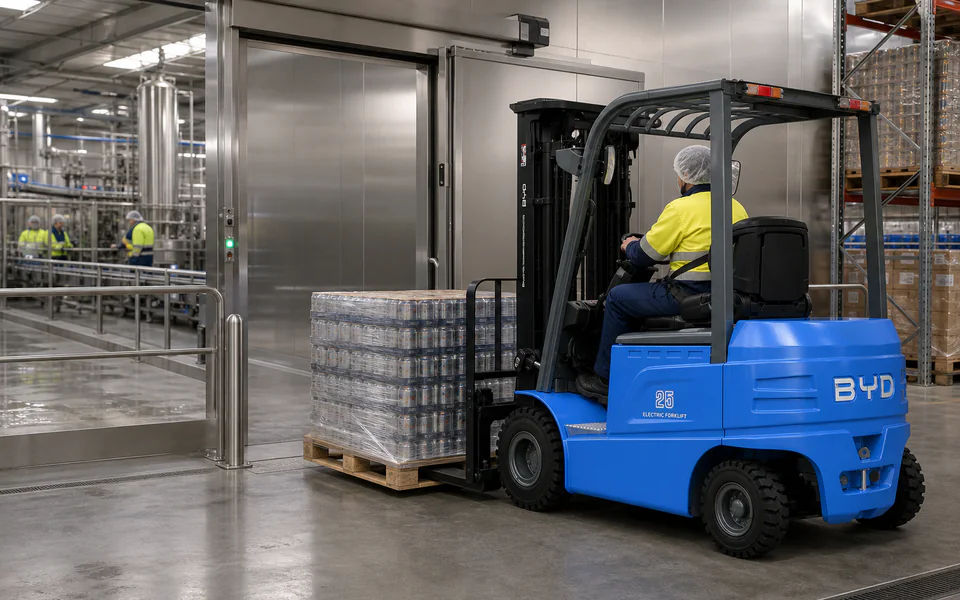
- BYD EL25-Pro — the food-industry default: 2.5 t, LFP chemistry, 100A fast charge, FFL mast for high racking and container work, tight ≈2,110 mm turning circle for older cool-store aisles.
- BYD EL20-Pro — the same package at 2 t for produce and lighter pallet work.
- EP EFX5-251 — for dry-goods and beverage warehouses running heavier pallets, with a modular battery for peak-season double shifts.
The honest caveats
Genuine cold-store duty (sub-zero, condensation cycling) and washdown environments need specification and warranty conditions confirmed model-by-model — say so in the online quote form and we’ll confirm with the dealer in writing before anything is promised. That’s a five-minute check that prevents a five-month argument.
Common questions
Food & Beverage forklift hire — FAQs
Are lithium forklifts suitable for food production areas?
Battery-electric machines produce no exhaust emissions, which removes the main air-quality objection to combustion forklifts indoors. For documented HACCP environments, tell us your audit requirements in the quote and we confirm the specification in writing.
Can these forklifts work in cold storage?
Chiller-temperature dock and staging work is generally fine; sustained freezer duty needs model-by-model confirmation of battery and hydraulic specification — we state what is confirmed in the written quote rather than assuming. LFP chemistry tolerates cold better than most lithium types, but condensation cycling between zones is the real design question.
How do charge windows fit around production and cleaning shifts?
Lithium opportunity charging works in the gaps: a 30–45 minute cleaning window on a 100A charger returns a meaningful share of the pack, and there is no equalisation or watering routine demanding a fixed overnight window.
Running food & beverage in Melbourne?
Tell us your loads, site and hours — we'll spec the right machine and quote it the same business day.