THE SHORT ANSWER
Electric forklifts suit food environments — no exhaust near product, quiet early starts — but cold changes the maths. Battery capacity falls as temperature drops (one industry source puts a lithium pack at roughly 80% of nominal capacity at −20 °C), charging should happen in a warmer zone, and moving a cold truck into warm humid air causes condensation that attacks electrics. Plan a buffer zone, size the battery for the real shift, specify non-marking tyres and a washdown-ready spec, and ask the supplier for the manufacturer's cold-store rating in writing before you sign.
Why food sites went electric first
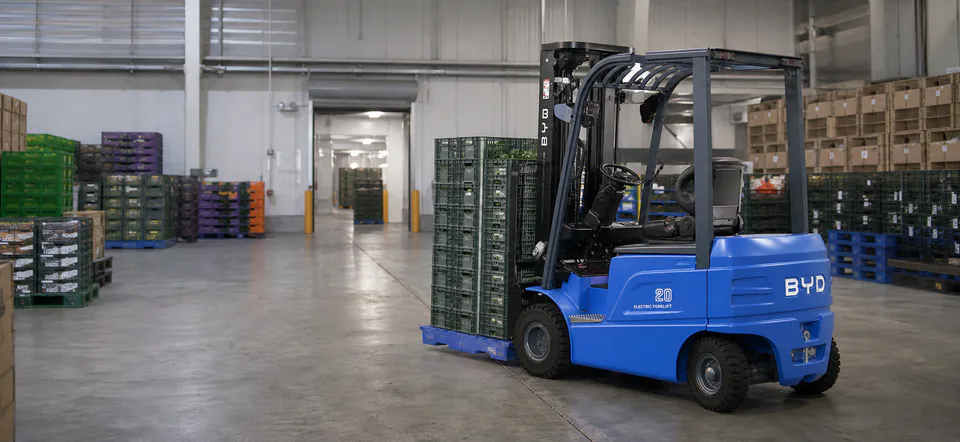
Food and beverage operators were among the earliest to leave LPG behind for an obvious reason: no exhaust near product, no gas bottles in the building, and quiet machines for 4 am starts. Our industry page for food and beverage covers that side. This guide is about the part that trips people up afterwards — temperature.
A truck that runs a full shift on the ambient side of the wall may not run a full shift inside the chiller, and a freezer changes the picture again. None of this rules out lithium; it changes how you size, charge and move the machine.
What cold does to a lithium battery
Battery chemistry slows down in the cold. Industry material on cold-store forklifts puts the usable capacity of a battery at roughly 80% of nominal at −20 °C, and recommends sizing the pack up for cold use because a truck that meets its runtime at room temperature may fall short in a freezer (Grepow, choosing cold storage forklifts). Lithium holds up better than lead-acid in this respect — lead-acid loses capacity faster in the cold and its electrolyte can freeze when discharged — but it is not immune.
Two practical consequences:
- Size for the cold shift, not the ambient one. Our EFX5 platform's modular pack (280 Ah standard, field-expandable to 560 Ah) exists for exactly this kind of case; the BYD EL25-Pro's 270 Ah LFP pack with 100 A fast charging is the other route. Which fits depends on how many hours the truck actually spends below zero — we size it in the fit assessment.
- Expect shorter runtime per charge in the freezer, and plan break-time top-ups into the roster rather than discovering it on a Friday afternoon.
Manufacturers publish operating-temperature ranges for their packs and some offer heated or cold-store-rated battery options. Treat vendor figures as indicative and ask for the rating in writing for the specific model and pack you will hire.
Where to charge
Charging a cold battery is the weak point. The same industry source notes that charging at around −20 °C is technically possible but slow, and recommends charging in a warmer area — its example is that charging efficiency improves markedly in an environment of roughly 0 to −5 °C compared with deep-freeze temperatures, with the charging zone normally warmer than the working zone.
The practical rule: put the charger outside the freezer, in the buffer or ambient area, and bring the truck out to charge. That also solves the next problem.
Condensation: the problem nobody budgets for
A truck that has worked in a freezer for half an hour has a surface close to freezer temperature. Drive it into a warm, humid dispatch area and water condenses on everything — including connectors, displays and the battery housing. Repeated cycles are how electrical faults start.
The accepted mitigation is a buffer zone: an intermediate area held around 0 °C with humidity controlled (the source above suggests below 40%) where the truck rests, charges or swaps batteries before going back in, and where it dries before re-entering the cold store. The same material recommends preheating the truck and battery before entry, keeping vehicles dry before they go back in, shortening lubrication intervals, and using cold-rated hydraulic oil and hoses. If a machine faults inside the freezer, remove it promptly and repair it in the buffer or maintenance area, not in the cold.
If your site has no buffer zone, say so in the quote request. It changes the recommendation — sometimes to a dedicated cold-store truck that never leaves the freezer, charged in place with a cold-rated charger.
The food-plant spec list
Cold is one half; hygiene and floors are the other. The items we specify for food sites:
| Item | Why |
|---|---|
| Non-marking tyres | Standard solid tyres leave black marks on food-grade floors; non-marking compounds remove the carbon black, at the cost of shorter tyre life (Adaptalift forklift tyres guide) |
| Sealed electrics and washdown-ready components | Daily washdown and condensation both put water near connectors |
| Food-grade hydraulic oil | Where the truck works over open product lines |
| Sealed, maintenance-free battery | No electrolyte, no acid, no battery-room ventilation — see our LPG vs electric guide |
| Blue-spot and audible warnings | Quiet trucks in busy pick areas need visibility — see traffic management |
| Cold-store rating in writing | Operating temperature range for the truck and the pack, from the manufacturer |
Questions to put to any supplier
- What is the manufacturer's operating temperature range for this truck and this battery pack?
- What runtime should I expect at my freezer temperature, and on what duty assumption?
- Where will the charger sit, and what supply does it need there? (Four of our five models need three-phase — see site requirements.)
- Is the spec washdown-ready and non-marking as standard, or an option?
- Does the hire agreement treat cold-store and washdown environments as standard use, or as a chargeable environment? Our fair wear and tear guide explains why that matters.
Where Ecolift fits
Our fleet is ambient-rated lithium counterbalance equipment with sealed LFP or lithium packs, and it does well in chillers, food processing and dispatch areas on the warm side of the wall. For deep-freeze duty we confirm the manufacturer's rating for the specific model and pack with the dealer before we quote, and we will tell you if a cold-store-specific machine is the better answer. Send us the temperatures, the hours and the layout in the quote form and the written quote will include a charging and buffer-zone plan.
Sources and review dates
- How to choose cold storage forklifts — Grepow (battery manufacturer). Checked 20 October 2026. Capacity at −20 °C, charging-zone temperatures, buffer-zone and condensation guidance. Vendor material; figures are indicative.
- Forklift tyres guide — Adaptalift Group. Checked 20 October 2026. Non-marking tyre description.
Cold-store performance depends on the specific truck, pack, duty cycle and temperatures. Confirm ratings with the manufacturer or dealer before relying on them.